

Treatment guide
Medical Weight Management
Clinically supervised support for a change you can actually sustain.
Provider-supervised care with regular review — not a program you follow alone and quietly abandon.
What is it?
Medical weight management means your progress is supervised by a clinician, reviewed at intervals, and adjusted as your body, health, and schedule change.
It combines clinical oversight with the practical parts — nutrition, activity, and follow-up — rather than treating any single element as the whole answer.
What is appropriate varies enormously between individuals, which is why any plan begins with a consultation and a history rather than a protocol.
What can it help improve?
- Weight that has not responded to repeated independent attempts
- Wanting clinical oversight rather than another self-directed program
- Energy and general metabolic wellbeing alongside weight itself
- Maintaining a change after the initial phase, which is where most plans fail
- Preparing for, or consolidating after, body treatments
Related goals: Weight & metabolic health
Who tends to consider it?
- People who have lost and regained weight several times and want a different structure.
- People who want a clinician involved rather than a commercial program.
- People whose priority is how they feel — energy, sleep, capacity — as much as a number.
- People considering body treatments who want the sequence advised honestly.
What it does — and what it doesn't do
What it does
- Provides clinical supervision and regular review
- Adapts the plan as circumstances change
- Treats maintenance as part of the plan rather than an afterthought
- Considers your wider health picture rather than weight alone
What it doesn't do
- Offer a fixed protocol that suits everyone
- Replace the underlying habits that determine long-term outcome
- Provide the same result to every person, or on the same timeline
- Get prescribed or planned before an individual clinical assessment
- Substitute for care from your own physician for unrelated medical conditions
What the appointment may involve
The first appointment is a conversation and a history: what you have tried, what happened, what your day actually looks like.
Your provider discusses which clinically appropriate options exist for you specifically, and what each would involve.
Nothing about medication, dosing, or specific regimens is published on this page, because those decisions are individual and clinical.
Follow-up is built into the plan from the start rather than arranged only when something stalls.
General educational description only. Anything specific to you — suitability, preparation, and aftercare — is discussed at consultation.
What results typically mean
The outcome people generally look for is steady, sustainable change with support at the points where they have previously stopped.
Progress is not linear, and a plan that assumes it is tends not to survive contact with real life.
Individual results vary substantially and are influenced by health history, medication, adherence, and circumstances.
Related results
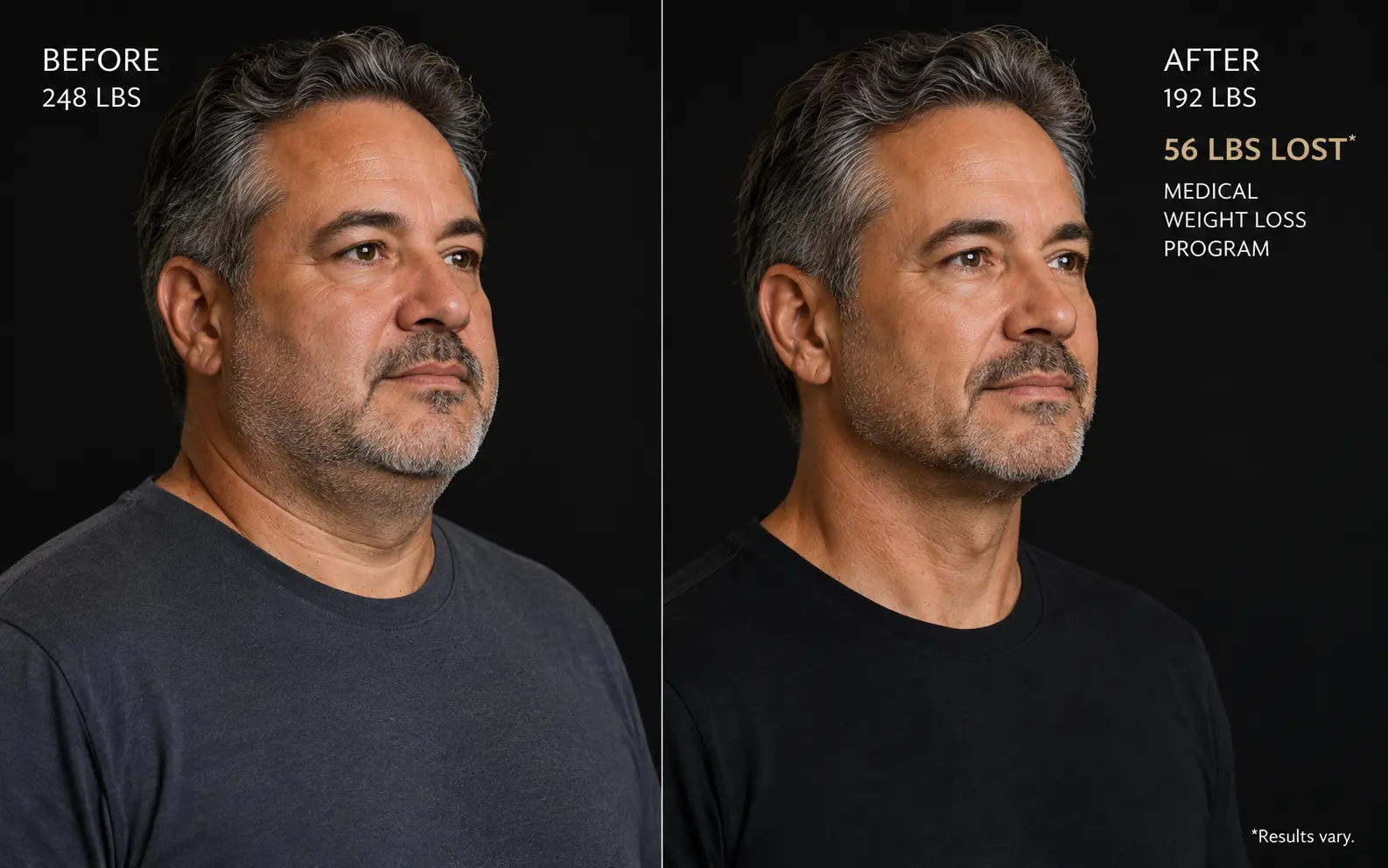
Medical Weight Management
Facial Definition • Overall Change • Clinical Support
The kind of change medically supervised weight management is designed to support, reviewed at every visit rather than promised up front.
Treatment example · Results may vary.
Treatment examples. Results may vary.
Timing and treatment series
This is an ongoing plan with review points rather than a course of treatments.
Review intervals are set by your provider based on how your plan is going.
Maintenance is discussed from the beginning, because it is the phase where the outcome is actually determined.
Recovery and downtime
There is no procedural downtime associated with medical weight management.
Any clinical considerations, side effects, or monitoring requirements are discussed with you individually as part of your care.
This page is educational and does not describe any specific medical treatment.
How this may fit with other treatments
Where body contouring is also a goal, weight is normally addressed first — contouring is more predictable at a stable weight.
Clinical wellness support often runs alongside, particularly around energy and sustainable habits.
Skin quality and hair health are sometimes affected during significant weight change, and can be planned for rather than reacted to.
Questions to ask your provider
- Given my history, what would you realistically expect over the first few months?
- How often would we review, and what happens if progress stalls?
- What does the maintenance phase look like?
- How does this interact with anything else I am considering here?
- What is this treatment unlikely to change for me?
- What does maintaining this look like, realistically, once we start?
- What would make you recommend against treating me today?
- What are you actually seeing when you look at my face, in your own words?
- What would you do first if this were staged over a year rather than one visit?
This is planned as a sequence rather than a single appointment, so cost arrives in stages. See how plans and payment work
Who you’d see
Providers for this area

Dr. Elena Marlowe, MD
Founder & Medical Director

Noelle Brandt, NP
Wellness & Hair Restoration Provider
What clients notice
“I felt supported without feeling judged.”
Common questions
Weight Management: frequently asked
Still deciding? Start with a conversation.
A consultation is where reading becomes a plan — staged, priced, and entirely yours to decline.
19 guides published · more in development