

Treatment guide
Hair Restoration (PRP / PRF & Scalp Health)
A clear answer about what is happening to your hair — and what can realistically help.
Most people arrive having already bought several products. The useful first step is assessment, not another bottle.
What is it?
Hair restoration at La Rive begins with a scalp assessment and history: pattern, timeline, family history, health changes, and what you have already tried.
PRP and PRF treatments concentrate growth factors from your own blood sample and deliver them to the scalp across a planned series.
Scalp and hair health care addresses the environment hair grows from, which is often part of the picture even when it is not the whole cause.
What can it help improve?
- Gradual thinning through the crown or part line
- A hairline that has changed over time
- Reduced density rather than defined bald areas
- Scalp health that is affecting hair quality
- Understanding whether what you are seeing is treatable at all
Related goals: Hair thinning
Who tends to consider it?
- People noticing thinning early, when there is more to work with.
- People who have used over-the-counter products without a clear result.
- People experiencing hair changes after illness, stress, or significant weight change.
- Men and women alike — pattern and cause differ, and so does the plan.
What it does — and what it doesn't do
What it does
- Starts with assessment rather than treatment
- Can support hair density in appropriate candidates
- Is planned as a series with review points
- Considers general health factors that affect hair
What it doesn't do
- Regrow hair where follicles are no longer viable
- Work equally well for everyone, or for every cause of hair loss
- Replace medical investigation where an underlying condition may be involved
- Deliver an immediate change — hair responds on its own slow cycle
- Substitute for surgical hair transplantation where that is what someone actually needs
What the appointment may involve
The first appointment is assessment and conversation: history, pattern, timeline, and what has already been tried.
Where relevant, your provider may recommend investigation of general health factors before treatment is planned.
If a PRP or PRF series is appropriate, the process is explained fully — including that it involves drawing a small blood sample.
A plan is set with review points, because hair changes are judged over months, not weeks.
General educational description only. Anything specific to you — suitability, preparation, and aftercare — is discussed at consultation.
What results typically mean
The improvement people typically look for is density and hair quality rather than a restored hairline.
Hair grows on a slow cycle, so change is assessed over months and photographs are genuinely useful.
Candidacy matters more here than in most treatments: earlier thinning generally has more to work with than long-established loss.
Related results
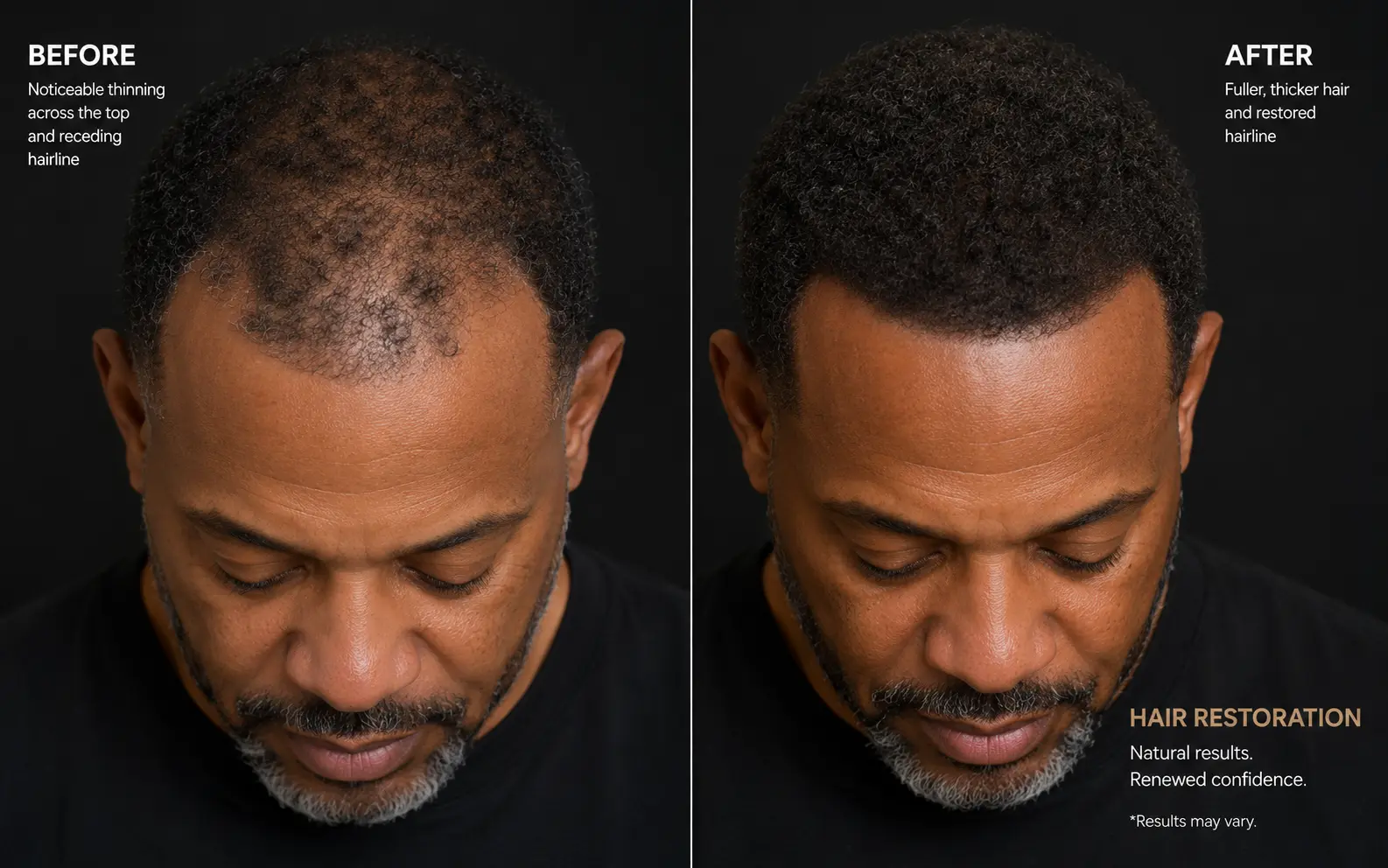
Hair Restoration
Thinning • Density • Hairline
Fuller-looking hair through previously thinning areas, and a hairline that reads denser.
Treatment example · Results may vary.
Treatment examples. Results may vary.
Timing and treatment series
Planned as a series, spaced across months, followed by review.
Some plans include periodic maintenance sessions; others do not.
Consistency matters, and an honest conversation about that belongs at the start rather than halfway through.
Recovery and downtime
Scalp treatments may leave temporary tenderness or redness; individual experience varies.
Your provider gives specific aftercare relevant to the treatment performed.
Downtime is generally limited, but ask if you have a particular schedule to plan around.
How this may fit with other treatments
General health factors — including significant weight change and nutrition — are often addressed alongside, because hair reflects them.
Clinical wellness support may be discussed as part of the same picture.
Where hair loss is well established, the honest conversation may be about surgical referral rather than in-clinic treatment.
Questions to ask your provider
- What pattern of loss am I actually showing, and what typically causes it?
- Am I a good candidate, or is this too established for this approach?
- What health factors should be investigated first?
- How will we judge whether this is working, and when?
- What is this treatment unlikely to change for me?
- What does maintaining this look like, realistically, once we start?
- What would make you recommend against treating me today?
- What are you actually seeing when you look at my face, in your own words?
- What would you do first if this were staged over a year rather than one visit?
This is planned as a sequence rather than a single appointment, so cost arrives in stages. See how plans and payment work
Who you’d see
Providers for this area

Dr. Elena Marlowe, MD
Founder & Medical Director

Noelle Brandt, NP
Wellness & Hair Restoration Provider

Brad Richardson, PA-C
Physician Assistant · Men's Aesthetics & Injectables
What clients notice
“They talked about the reason for the thinning before talking about treatment.”
Common questions
Hair Restoration: frequently asked
Still deciding? Start with a conversation.
A consultation is where reading becomes a plan — staged, priced, and entirely yours to decline.
19 guides published · more in development