

Treatment guide
Under-Eye Rejuvenation
Look less tired — without changing your eyes.
The under-eye is the area we assess most carefully and decline most often. This guide explains why, and what the alternatives are when treatment is not the right answer.
The short answer
Under-eye shadowing has several different causes, and they respond to completely different things. Hollowing may respond to careful volume support. Crepey skin responds to skin-quality treatment, not volume. Puffiness and fluid often respond to neither. Pigment is its own problem again.
That is why an under-eye plan begins with working out what you are actually seeing. It is also why the honest answer here is more often “not yet”, or “not with this”, than in almost any other area of the face.
What is it?
Under-eye rejuvenation is not one treatment. It is a small group of different approaches selected according to what is causing the shadowing — which may be volume loss beneath the eye, skin thinning and texture change, pigment, fluid, or simply the anatomy of the orbital rim you were born with.
Where hollowing is the dominant cause, cautious volume support may be considered. Where skin quality is the dominant cause, energy-based or collagen-stimulating treatment is usually the better tool. Where fluid or anatomy is the dominant cause, aesthetic injectable treatment may not be appropriate at all.
How it works
Volume support works by restoring structure beneath a hollow so that light no longer falls into it. It changes the shadow, not the skin.
Skin-quality treatment works the other way around: it addresses the thin, crepey texture that makes the area look tired even when there is no hollow to fill.
Because these mechanisms are different, using the wrong one does not simply underperform — it can make the area look worse. Under-eye tissue is thin, mobile, and unforgiving of product placed where it was not needed.
Why assessment comes first
Four different things that all look like “tired”
- Hollowing — a genuine loss of support beneath the eye, casting a shadow. Sometimes treatable with careful volume.
- Skin quality — thin, crepey, finely lined skin. Treated by improving the skin, not by adding volume beneath it.
- Pigment — true dark circles, often inherited or related to skin tone. Volume does nothing for this.
- Fluid and anatomy — puffiness, allergy, sleep, and the shape of the orbital rim. Frequently not an injectable question at all.
What can it help improve?
- A hollow or trough beneath the eye that casts a shadow in most lighting
- Looking tired in photographs regardless of how much you slept
- Crepey or finely lined skin in the lower lid area
- A tear-trough shadow that makeup no longer covers convincingly
Related goals: Looking tired, Facial balance & volume
Who tends to consider it?
- People repeatedly told they look tired when they do not feel tired.
- People who have noticed the area change gradually over several years.
- People considering filler elsewhere on the face who assumed the under-eye would be treated at the same time.
- People who have had under-eye filler previously and were not happy with the result.
Who tends to be a reasonable candidate?
- The shadowing is genuinely caused by hollowing rather than by pigment, fluid, or skin texture alone
- The skin in the area still has reasonable quality and elasticity
- There is no significant morning puffiness or fluid retention
- You understand this area is treated conservatively and often in stages
- You are comfortable being told that waiting is the recommendation
What it does — and what it doesn't do
What it does
- Reduces shadowing where a true hollow is causing it
- Can soften the “tired” impression the lower face reads as
- Can be paired with skin-quality treatment where texture is a factor
- Is assessed before it is offered, and often staged over more than one visit
What it doesn't do
- Does not remove under-eye pigmentation or genetic dark circles
- Does not treat puffiness caused by fluid, allergy, or sleep
- Does not tighten significant lower-lid skin laxity
- Does not change orbital bone anatomy
- Does not substitute for surgical assessment where that is what the area requires
When it may not be appropriate
- When the shadow is pigment rather than hollowing — volume will not lighten it
- When there is ongoing fluid retention or morning puffiness, which volume can make more visible
- When lower-lid laxity is the dominant finding, which is a surgical question rather than an injectable one
- When previous product remains in the area and needs to be assessed, or resolved, first
- When the change you are describing is better addressed by sleep, thyroid, allergy, or general health review with your own physician
Restraint
When the right answer is to wait
Under-eye treatment is easier to add than to undo, and the area shows a heavy hand more obviously than anywhere else on the face. Where the assessment is uncertain, the safer sequence is to treat something adjacent, review, and decide later with more information.
Being told to wait is not the same as being turned away. It usually means there is a clearer first step available, and that the under-eye is best judged after that step has been taken.
What the appointment may involve
Assessment comes first, and takes longer here than elsewhere. You will usually be asked to look in several directions and under different lighting, because a hollow and a pigment shadow do not behave the same way when the light moves.
If treatment is appropriate, it is conservative by design and frequently staged — a smaller first step reviewed later is considered safer here than a single definitive treatment.
If treatment is not appropriate, that is said plainly, with the reason, and the alternatives are discussed instead.
General educational description only. Anything specific to you — suitability, preparation, and aftercare — is discussed at consultation.
What results typically mean
A good under-eye result is usually described by other people as looking rested rather than as looking treated. Nobody should be able to identify what changed.
Improvement is often partial rather than complete. Where pigment or skin texture contributes to the shadow, addressing the hollow alone changes some of what you see, not all of it.
Related results
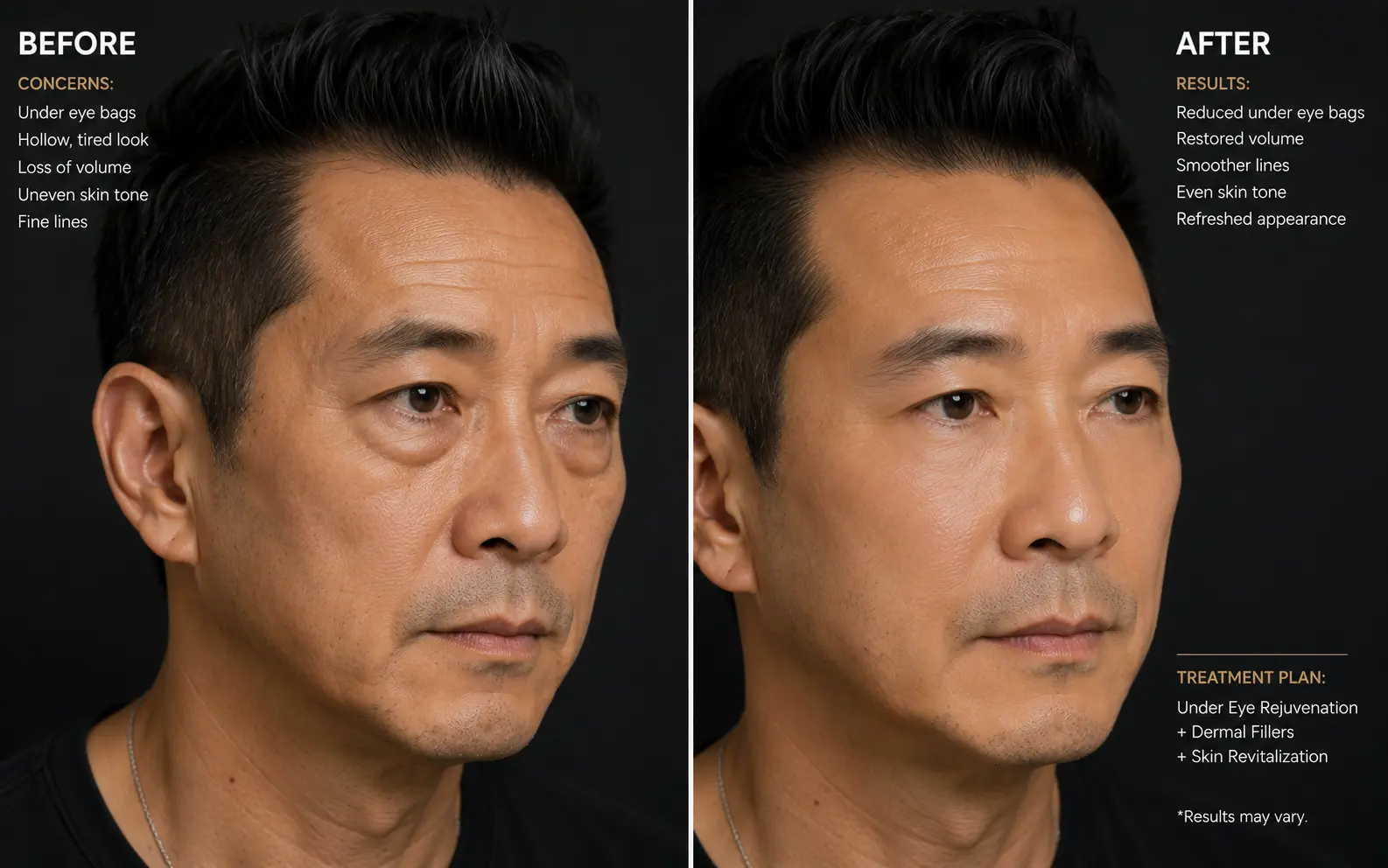
Under-Eye Rejuvenation
Under-Eye Hollowing • Tired Appearance • Skin Quality
A less tired, more rested look through the under-eye and midface, with skin that reads smoother and more even.
Treatment example · Results may vary.
Treatment examples. Results may vary.
Timing and treatment series
Where volume is used, review is typically arranged some weeks later rather than treating fully in one sitting.
Where skin quality is the route, change is gradual and measured across a series rather than after a single appointment.
Recovery and downtime
Bruising is more likely here than in most areas of the face, because the tissue is thin and vascular. Plan accordingly around events.
Some swelling in the first days is normal and can temporarily exaggerate the area before it settles.
Your provider will give you aftercare specific to what was done and to your own history.
How this may fit with other treatments
Midface support is often considered before the under-eye itself. Restoring structure slightly lower on the face can change how much shadow remains — sometimes enough that the under-eye needs nothing.
Skin-quality treatment may be sequenced first where crepiness is the more visible problem.
Where several things are contributing, the plan usually addresses them one at a time so it is clear what worked.
See the treatments we offer in Injectables & Facial Aesthetics
Other approaches worth considering
Skin-quality treatment — collagen-stimulating or energy-based approaches — where thinning and texture rather than hollowing are the main cause.
Pigment-directed skin treatment where the shadow is colour rather than depth.
Midface support alone, which changes under-eye shadowing indirectly in some faces.
Doing nothing for now, reviewed later. In this area that is a legitimate clinical recommendation rather than a deferral.
Referral for surgical or ophthalmic opinion where the finding is beyond what aesthetic treatment should attempt.
Questions to ask your provider
- What do you think is actually causing the shadow in my case — hollow, pigment, skin, or fluid?
- Is this an area where you would treat me today, and if not, what would change that?
- How much of what I am seeing do you expect this to change, realistically?
- What is the plan if I bruise or swell more than expected?
- What are you actually seeing when you look at my face, in your own words?
- What would you do first if this were staged over a year rather than one visit?
- What is this treatment unlikely to change for me?
- What does maintaining this look like, realistically, once we start?
- What would make you recommend against treating me today?



Common questions
Under-Eye: frequently asked
The eyes are the last place to be casual.
Still deciding? Start with a conversation.
A consultation is where reading becomes a plan — staged, priced, and entirely yours to decline.
19 guides published · more in development