

Treatment guide
Dermal Fillers & Facial Balancing
Support rebuilt where structure has quietly gone missing — cheeks, temples, chin, jawline.
Volume loss usually reads as tiredness long before it reads as age. Facial balancing treats the face as one structure rather than a set of separate complaints.
What is it?
Dermal filler is a gel placed beneath the skin to restore support in areas where the underlying framework has flattened. It is not the same thing as a wrinkle relaxer, and the two address different problems.
Facial balancing is the planning discipline around it: assessing proportion across the whole face — projection, width, height, symmetry — before deciding whether anything needs adding at all.
Most fillers used in aesthetic practice are temporary and break down over time, which is one reason a staged approach is usually preferred to a single large treatment.
What can it help improve?
- Flatness through the cheek or midface
- Hollowing at the temples
- A jawline or chin that has lost definition
- Midface shadowing that makes the face look tired in photographs (the under-eye area itself is assessed separately — see the under-eye guide)
- Folds that deepen because the tissue above them is no longer supported
- Asymmetry that has become more noticeable over time
Related goals: Looking tired, Facial balance & volume
Who tends to consider it?
- People who look drawn or tired in photographs regardless of how well they slept.
- People who feel their face has changed shape rather than simply gained lines.
- People considering several small treatments who would rather understand the order first.
- People who have had filler elsewhere and want a second opinion before continuing.
What it does — and what it doesn't do
What it does
- Restores support and projection where volume has been lost
- Can improve definition along the jaw, chin, or cheek
- Can soften folds that exist because of missing support underneath
- Is generally temporary, and generally reversible in the case of certain gel types — your provider will explain which applies to you
What it doesn't do
- Tighten loose skin — volume and laxity are different problems with different solutions
- Improve skin texture, pigment, or surface quality
- Replace weight loss, surgery, or a facelift where those are what someone actually wants
- Stop the underlying changes that caused the volume loss
- Need to make your face look bigger or obviously filled — that is a planning failure, not an inevitable outcome
What the appointment may involve
Consultation comes first, and for facial balancing it is the substantial part of the process. Your provider assesses proportion, movement, skin quality, and history before proposing anything.
Where treatment is appropriate and you choose to proceed, placement is done in stages across the planned area. Comfort measures are discussed with you beforehand.
You will normally see an immediate change, some of which is temporary swelling rather than final result.
A review is generally arranged so the result can be judged once settled — that is the point at which more may or may not be recommended.
General educational description only. Anything specific to you — suitability, preparation, and aftercare — is discussed at consultation.
What results typically mean
The improvement people usually want here is structural: looking rested and proportionate, rather than looking full.
The most common feedback in a good result is that people notice you look well without identifying why.
Longevity varies by product type, placement, area, and individual metabolism, so your provider will set expectations specific to your plan.
Related results
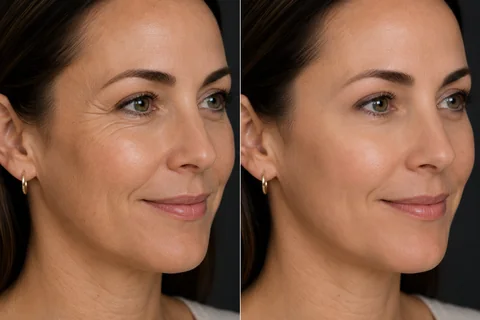
Facial Aesthetics
Expression Lines • Eye Area • Natural-Looking Refinement
A refreshed appearance around the eyes while preserving natural expression and facial character.
Treatment example · Results may vary.
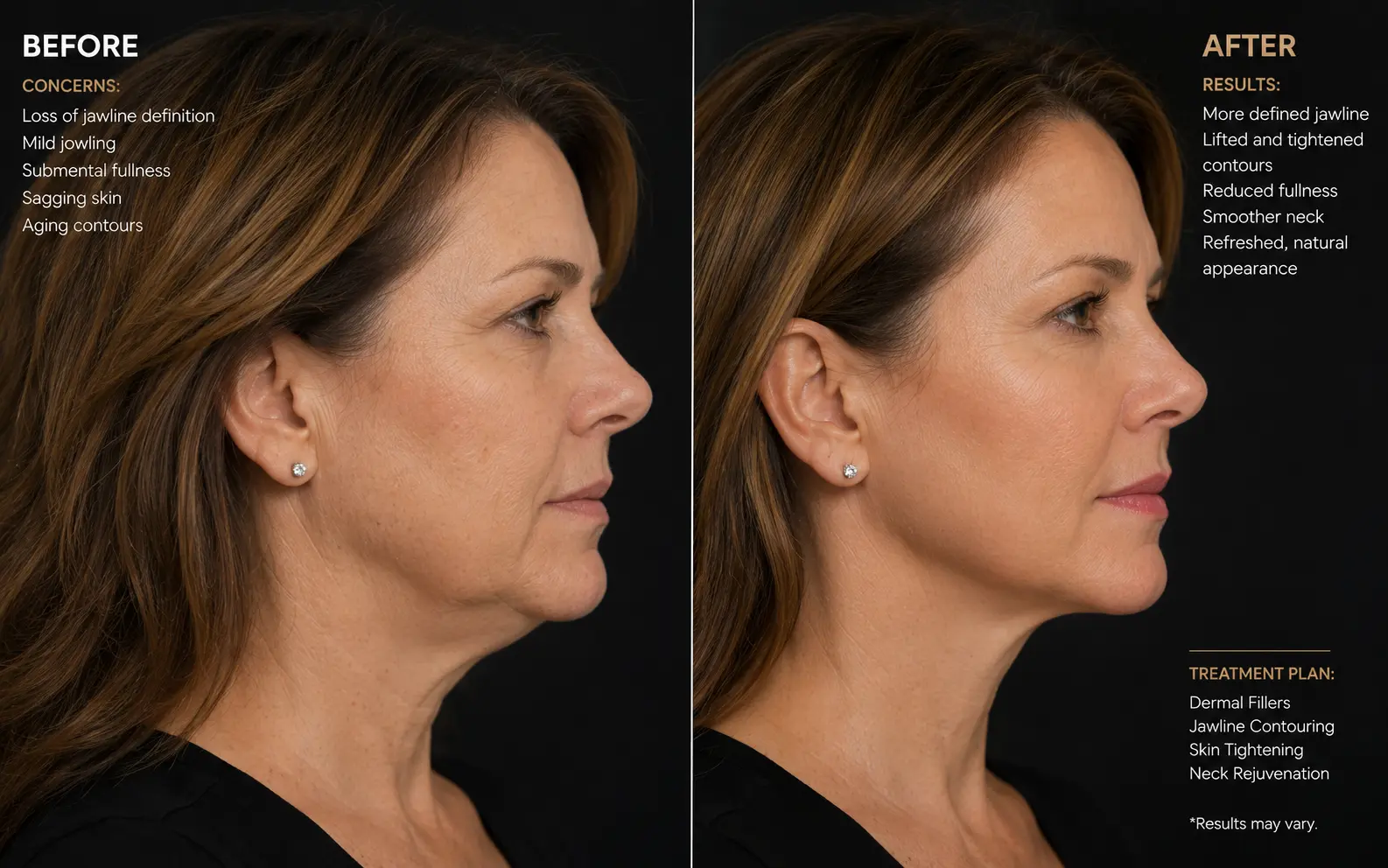
Facial Balancing & Jawline Definition
Jawline • Lower Face • Contour
A cleaner line along the jaw and lower face, planned around existing proportions rather than reshaping them.
Treatment example · Results may vary.
Treatment examples. Results may vary.
Timing and treatment series
Facial balancing is deliberately staged. Treating one area, letting it settle, then reassessing tends to produce a more natural outcome than treating everything at once.
Some people complete a plan over several months; others treat one area and stop there, which is a legitimate result.
Maintenance intervals are individual, and are usually judged by how your own result behaves rather than by a schedule set in advance.
Recovery and downtime
Swelling and bruising are common with injectable treatment and vary considerably by area and by individual.
Recovery expectations differ meaningfully between areas — lips behave differently to cheeks — so this is discussed specifically rather than generally.
Plan treatment away from significant events. Your provider will advise how much time to leave.
How this may fit with other treatments
Structure is usually addressed before surface. Correcting support first often changes what — if anything — still needs resurfacing or relaxing afterwards.
Collagen-stimulating treatment may be discussed where the goal is gradual quality change rather than immediate contour.
Skin health work sits alongside almost every contour plan, because good structure under poor-quality skin only half works.
See the treatments we offer in Injectables & Facial Aesthetics
Questions to ask your provider
- Is what bothers me actually volume loss, or is it skin laxity?
- If we treat only one area this year, which one changes the most?
- What would you expect this to look like as it wears off?
- What are you actually seeing when you look at my face, in your own words?
- What would you do first if this were staged over a year rather than one visit?
- What is this treatment unlikely to change for me?
- What does maintaining this look like, realistically, once we start?
- What would make you recommend against treating me today?
Who you’d see
Providers for this area

Dr. Elena Marlowe, MD
Founder & Medical Director

Avery Sloane, RN
Nurse Injector & Aesthetic Provider

Brad Richardson, PA-C
Physician Assistant · Men's Aesthetics & Injectables
What clients notice
“The conversation was about my face, not about selling me syringes.”
Common questions
Dermal Fillers: frequently asked
Still deciding? Start with a conversation.
A consultation is where reading becomes a plan — staged, priced, and entirely yours to decline.
19 guides published · more in development