

Treatment guide
Wrinkle Relaxers (Neuromodulators)
Softer expression lines, and a face that reads rested rather than treated.
The most commonly requested treatment in aesthetic medicine, and the one most often over-done elsewhere. At La Rive it is dosed conservatively and reviewed before anything is added.
What is it?
A wrinkle relaxer — clinically, a neuromodulator — temporarily reduces the pull of the specific small muscles that fold the skin when you make an expression. Less folding means the skin above has less reason to crease.
It is placed in mapped positions across the treated area rather than spread evenly, because the muscles being addressed are not the same size or strength in any two faces.
The effect is temporary by design. Muscle activity returns gradually, which is also what makes it a low-commitment place for many people to start.
What can it help improve?
- Horizontal lines across the forehead
- The vertical lines between the brows that can read as a permanent frown
- Lines at the outer corners of the eyes
- A brow that has started to sit lower or heavier than it used to
- Small movement lines around the mouth, chin, or jaw in some cases
Related goals: Fine lines & expression lines, Looking tired, Men's aesthetics
Who tends to consider it?
- People who look tired or cross in photographs when they do not feel either.
- People whose lines used to disappear at rest and are now faintly visible all the time.
- People who want to slow the deepening of lines that are still shallow.
- People who want the smallest possible intervention as a first step into aesthetic treatment.
- Men who want the change to be invisible as a treatment and visible only as looking less worn out.
What it does — and what it doesn't do
What it does
- Softens lines caused by movement
- Can subtly lift or balance the position of the brows
- Reduces the deepening of a line over time when treated consistently
- Wears off gradually — nothing about it is permanent
What it doesn't do
- Fill or erase deep static lines that are already etched into the skin at rest — those usually need skin or volume work as well
- Restore lost facial volume or structure
- Improve skin quality, pigment, texture, or laxity
- Tighten loose skin on the neck or jawline
- Have to freeze your expression — that is a dosing and planning outcome, not an inevitability
What the appointment may involve
The appointment starts with your provider watching your face move: raising, frowning, squinting, smiling. Where your lines come from matters more than where they currently sit.
Treatment itself is brief, and most people describe the sensation as a series of quick pinches. There is no anaesthetic requirement for most areas.
You are usually able to return to your day immediately, with a short list of common-sense aftercare points given by your provider.
A review is normally arranged a couple of weeks later, because that is when the effect can be judged and adjusted rather than guessed at.
General educational description only. Anything specific to you — suitability, preparation, and aftercare — is discussed at consultation.
What results typically mean
The improvement people generally look for is a softening, not a disappearance: lines that no longer announce themselves, and an expression that still belongs to you.
Onset is gradual rather than instant, and the result is assessed at the review point rather than the next morning.
Individual response varies. Depth of line, muscle strength, skin quality, and history of previous treatment all influence what is realistic.
Related results
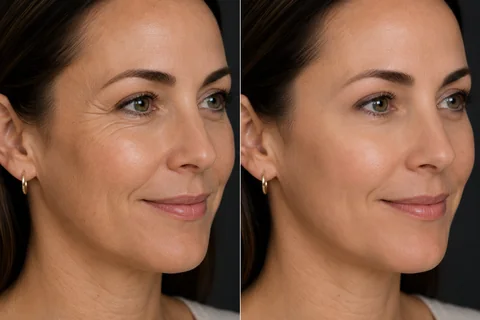
Facial Aesthetics
Expression Lines • Eye Area • Natural-Looking Refinement
A refreshed appearance around the eyes while preserving natural expression and facial character.
Treatment example · Results may vary.
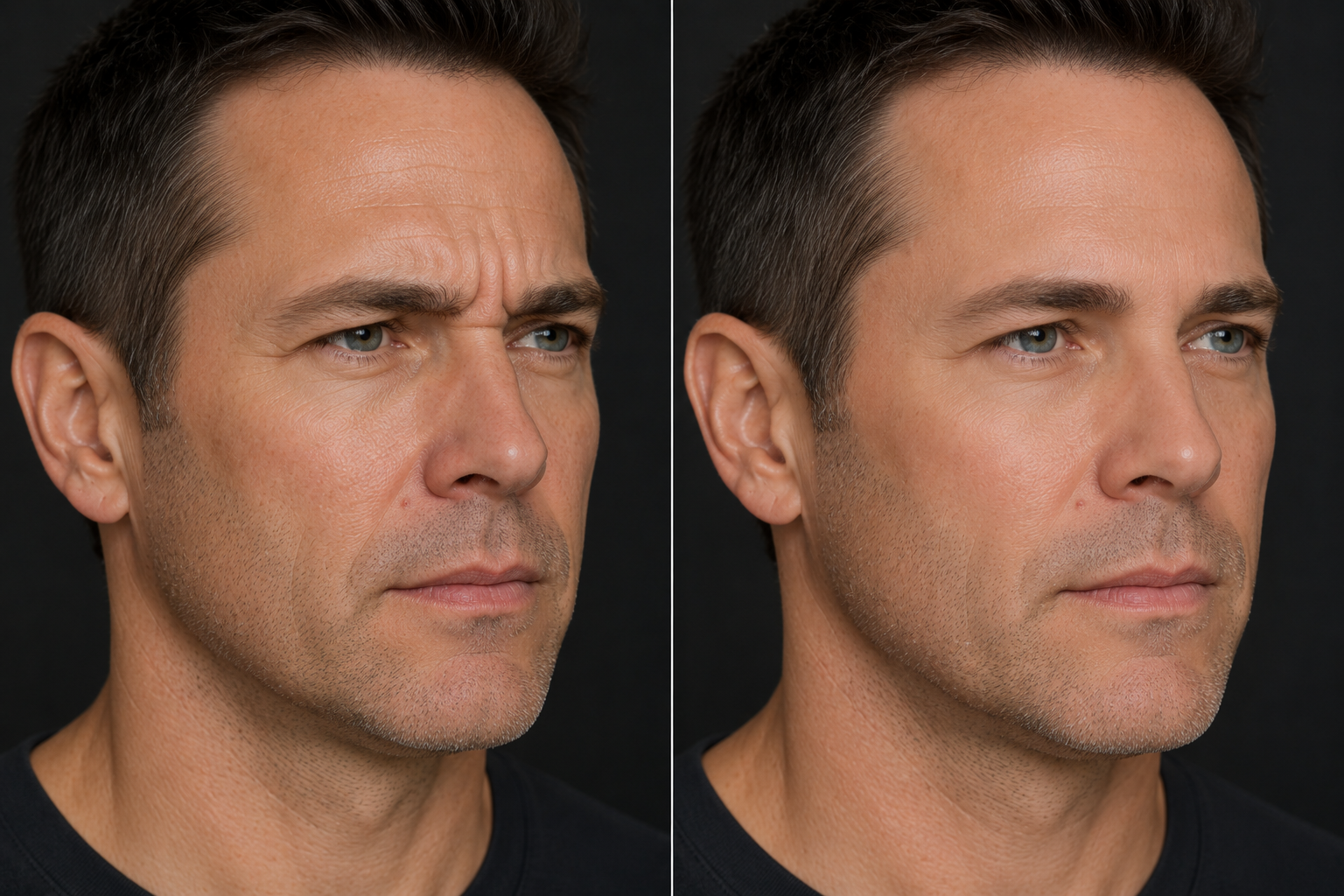
Men's Aesthetics
Forehead • Expression Lines • Refreshed Appearance
A rested, refined look designed to soften visible expression lines without changing what makes him look like himself.
Treatment example · Results may vary.
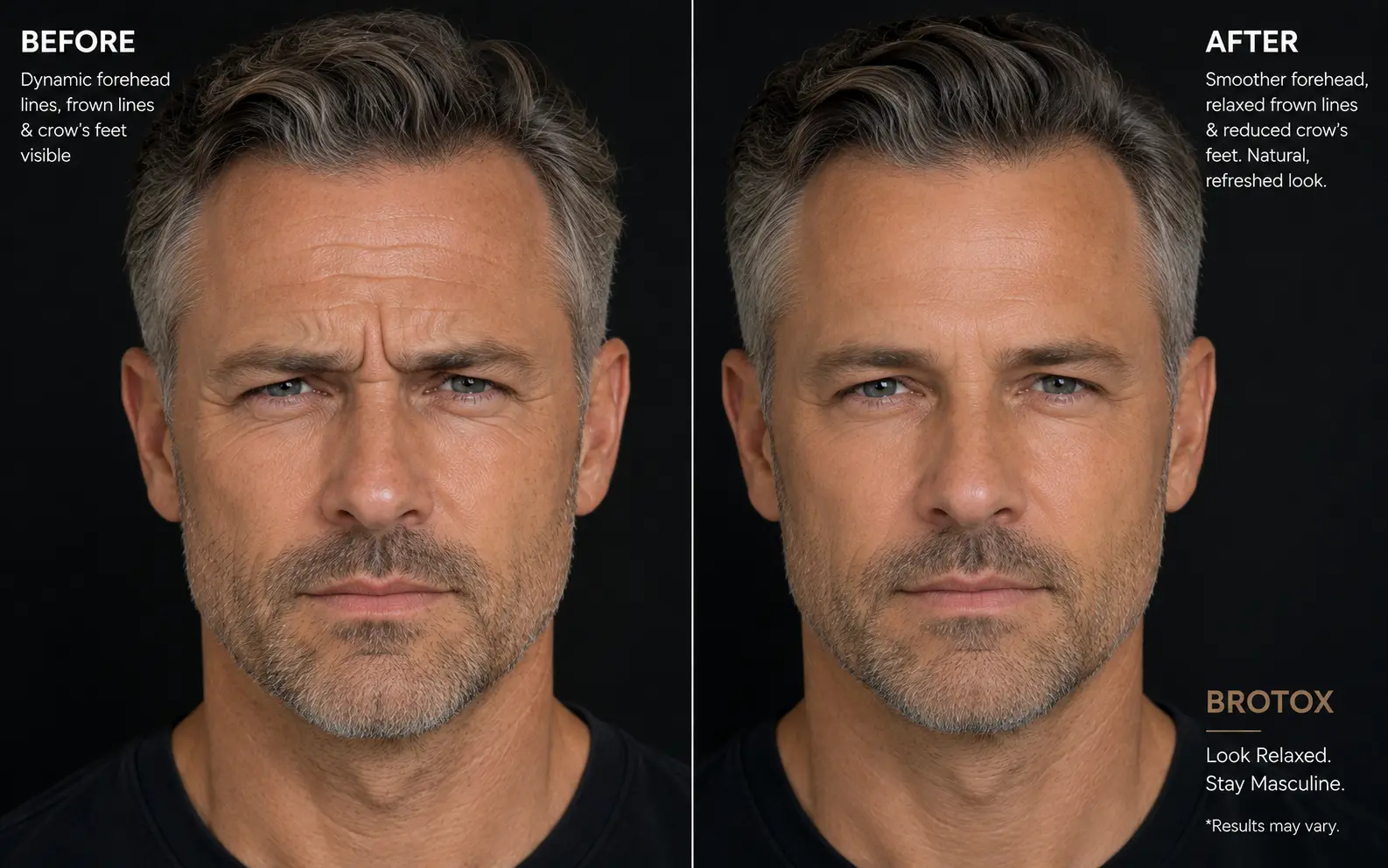
Men's Expression Lines
Forehead • Frown Lines • Eye Area
A smoother forehead and softer frown lines — less tired-looking, still recognisably masculine.
Treatment example · Results may vary.
Treatment examples. Results may vary.
Timing and treatment series
The effect is temporary and reduces over time, so people who like the result generally return periodically rather than once.
Intervals vary by person and by area, and are set with your provider based on how your own result has behaved — not on a fixed calendar rule.
Many people are treated less often than they expect once their lines have softened.
Recovery and downtime
Downtime is typically minimal for this category of treatment, though small injection marks, temporary redness, or bruising are possible.
Your provider will give you the specific aftercare points relevant to the area treated and to your own history.
If you have an event coming up, say so during consultation — timing is easy to plan around, and awkward to fix afterwards.
How this may fit with other treatments
Wrinkle relaxers address movement. They are often planned alongside treatments that address the other two variables: skin quality and structural volume.
Where lines are etched at rest, resurfacing or collagen-stimulating treatment may be discussed as a complement rather than a substitute.
Where the face reads hollow as well as lined, contour planning is usually considered first, so relaxers are not asked to do a job they cannot do.
See the treatments we offer in Injectables & Facial Aesthetics
Questions to ask your provider
- Which of my lines come from movement, and which are now static?
- What is the most conservative starting dose you would use for me?
- What are you actually seeing when you look at my face, in your own words?
- What would you do first if this were staged over a year rather than one visit?
- What is this treatment unlikely to change for me?
- What does maintaining this look like, realistically, once we start?
- What would make you recommend against treating me today?
Who you’d see
Providers for this area

Dr. Elena Marlowe, MD
Founder & Medical Director

Avery Sloane, RN
Nurse Injector & Aesthetic Provider

Brad Richardson, PA-C
Physician Assistant · Men's Aesthetics & Injectables
What clients notice
“She actually recommended doing less than I originally asked for.”
Common questions
Wrinkle Relaxers: frequently asked
Beautiful results shouldn't announce the treatment.
Still deciding? Start with a conversation.
A consultation is where reading becomes a plan — staged, priced, and entirely yours to decline.
19 guides published · more in development