

Treatment guide
Lip Enhancement
Definition, hydration, and shape measured against your own proportions.
Lip work has a reputation problem, and most of it comes from treating volume as the goal. Shape, border, and balance usually matter more than size.
What is it?
Lip enhancement covers a range of approaches, from subtle hydration to defining the border or correcting asymmetry. Filler is the most common tool, but not the only consideration.
The assessment looks at the lips in relation to the rest of the face: the distance between nose and lip, the proportion of upper to lower, the way the lips sit when relaxed and when smiling.
Most La Rive lip plans begin conservatively and are reviewed before anything further is considered.
What can it help improve?
- Lips that have thinned or lost definition over time
- An indistinct or blurred lip border
- Uneven upper-to-lower proportion
- Asymmetry between the two sides
- Dryness and a flat, undefined appearance
- Fine vertical lines around the mouth, in combination with other treatment
Related goals: Lip shape & definition
Who tends to consider it?
- People who want definition rather than obvious volume.
- People whose lips have gradually thinned and no longer suit their face the way they used to.
- People who have wanted lip treatment for a long time and are wary of the results they have seen elsewhere.
- People who have had lip filler before and want a more restrained approach this time.
What it does — and what it doesn't do
What it does
- Can define the border and improve shape
- Can restore lost fullness in proportion to the rest of the face
- Can improve symmetry to a degree
- Can support hydration and a healthier-looking surface
What it doesn't do
- Change the shape of your mouth into someone else's
- Treat sun damage, pigment, or deep lines around the mouth on its own
- Correct dental or skeletal structure
- Stay indefinitely — lip treatment is temporary and metabolises
- Have to look treated. If it does, too much was placed or it was placed in the wrong plane
What the appointment may involve
Assessment first: your provider will look at your lips at rest and in movement, and discuss what specifically you would like to change.
Comfort is discussed before anything begins; lips are more sensitive than most treated areas.
Treatment is normally brief, and you will see an immediate change that includes swelling as well as result.
A review is generally arranged once settled, and that is the point where anything further is considered.
General educational description only. Anything specific to you — suitability, preparation, and aftercare — is discussed at consultation.
What results typically mean
The improvement most people are looking for is definition and balance — lips that look like a good version of their own rather than a different set.
Because swelling is prominent in this area, the early appearance is not the outcome. Judgement is deferred to the review point.
Longevity varies by individual and by how much movement the area sees.
Related results
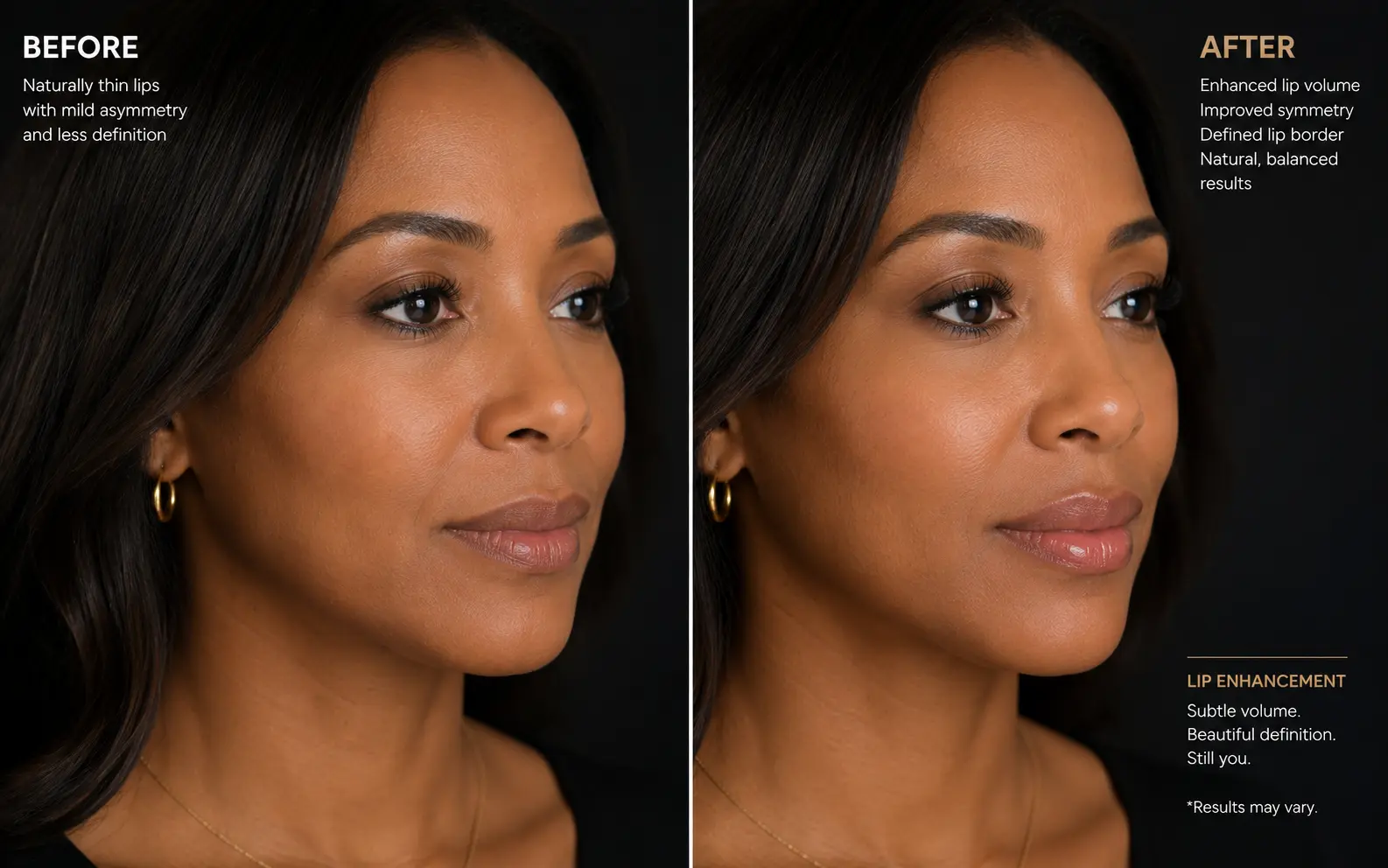
Lip Enhancement
Lip Volume • Symmetry • Definition
Subtle volume and a more defined lip border, measured against the rest of the face rather than added for its own sake.
Treatment example · Results may vary.
Treatment examples. Results may vary.
Timing and treatment series
Many people begin with a conservative treatment and reassess before adding anything further.
Where a larger change is the eventual goal, staging it across visits generally produces a more natural result than achieving it in one.
Maintenance is individual, and some people choose not to repeat treatment at all.
Recovery and downtime
Lips swell more than most areas, and bruising is common. This is normal rather than a complication, but it is a genuine planning consideration.
Recovery time varies between people. Do not schedule lip treatment close to an event.
Your provider will give aftercare specific to you.
How this may fit with other treatments
Lip treatment is often planned alongside a broader facial balancing assessment, because lips read differently depending on chin projection and midface support.
Fine lines around the mouth may be discussed as a separate resurfacing conversation rather than treated with filler.
Where the concern is mainly surface quality, skin health treatment may be recommended before or instead of volume.
See the treatments we offer in Injectables & Facial Aesthetics
Questions to ask your provider
- What proportion would you consider natural for my face specifically?
- How conservative can a first treatment reasonably be?
- How will this look as it wears off?
- What are you actually seeing when you look at my face, in your own words?
- What would you do first if this were staged over a year rather than one visit?
- What is this treatment unlikely to change for me?
- What does maintaining this look like, realistically, once we start?
- What would make you recommend against treating me today?
Who you’d see
Providers for this area

Dr. Elena Marlowe, MD
Founder & Medical Director

Avery Sloane, RN
Nurse Injector & Aesthetic Provider

Brad Richardson, PA-C
Physician Assistant · Men's Aesthetics & Injectables
What clients notice
“He just said I looked really good.”
Common questions
Lip Enhancement: frequently asked
Your features. Your goals. Your version of beautiful.
Still deciding? Start with a conversation.
A consultation is where reading becomes a plan — staged, priced, and entirely yours to decline.
19 guides published · more in development